Introduction Starting a demanding new job often comes with an unspoken pressure to prove yourself. You want to show your manager that you are reliable, demonstrate your skills, and become someone the team can count on. So, whenever another task comes your way, saying yes feels like the safest choice. But what happens when every yes leaves you with less time for your existing responsibilities, personal life, and well-being? Learning to say no is not about avoiding hard work. It is about understanding your limits, protecting your priorities, and making sure your efforts create meaningful results. The Fear of Disappointing Others In a new role, setting boundaries can feel uncomfortable. You may worry that declining a request will make you seem uncooperative or less committed than your colleagues. This fear can lead you to accept unrealistic deadlines, volunteer for unnecessary work, and remain available long after your working hours end. Over time, these habits can create...
 Introduction
Karsanbhai Patel, the low profile founder of Nirma, started making detergent by mixing Soda Ash with other chemicals. He used to make detergent in the backyard of his house and sell at his own cycle. He directly challenged the veterans like Unilever and Proctor & Gamble by grabbing more than 60% market share. Story of Nirma & Karsanbhai Patel
Karsanbhai Patel was a son of a small farmer and he worked as a lab technician at one of the Government Department of Mining and Geology in Gujarat. The job security and flexible working hours of a government sector allowed him to explore his passion for chemistry. He took up the challenge of making low-cost yet high-quality detergent powder.Don't forget to watch a best video on biography of Dr BR Ambedkar.
At that time, Hindustan Unilever's Surf was the market leader and was considered as a luxury item, the cost of one KG of Surf was around Rs.13. He started his experiment by using Soda Ash to make a detergent and after multiple trials and errors, he was able to make a good detergent. Karsanbhai started selling his detergent on his cycle after office hours at the mere cost of Rs.3 per KG. He named this detergent after his daughter. Karsanbhai Patel had recently lost her daughter in a car accident and her name was Nirupama and hence he named this product "Nirma" after his daughter‘s name.
Karsanbhai‘s dream was to give the best education to her daughter and see her become a successful lady. Therefore, he decided to give her name to this detergent and make her immortal. By the 1980s Nirma became a market giant in Gujarat and seeing this potential, Karsanbhai left his secured job to pursue this business as a full-time venture. Patel worked on making a strong supply chain to sell his product across India. Shortly, he noticed that retailers outside Gujarat were very hesitant in selling his detergent. The Nirma brand was not known outside Gujarat and this resulted in negative cash flow, delayed payments, and very heavy losses to Patel. After doing a detailed analysis, he decided to take a risky yet pivotal step by making a brilliant marketing plan and promoting his formula. He was able to successfully make a legendary jingle "Hema, Rekha, Jaya aur Sushma Sabki Pasand Nirma." 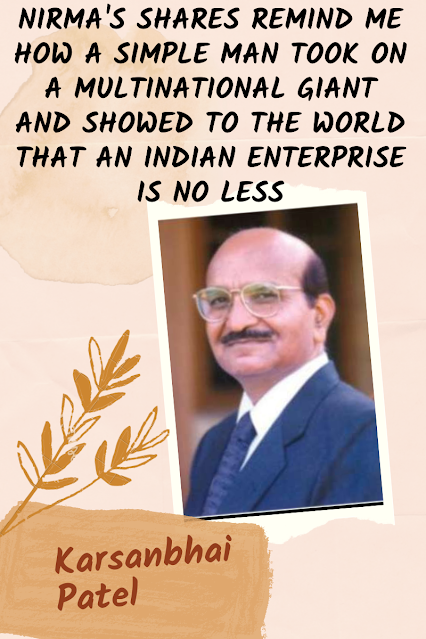
This ad targeted the average middle-class women who were just concerned about the household responsibility but are now glamorous, confident, and ready to face any adversity. Inspired by the campaign, customers started demanding Nirma products. After creating the demand in the market, Karsanbhai flooded the market with his Nirma detergent and this resulted in record-breaking sales. By the end of 1990, Nirma grabbed a whopping 60% market share of the Indian detergent market and significantly outsold Hindustan Unilever's Surf. Today Nirma employs more than 18000 people and is available in the remotest part of India. Karsanbhai's vision to develop and transform India can be seen through the establishment of the Nirma Institute of Technology, the Nirma Educational and Research Foundation, and other NGOs which work under the Nirma brand. This shows the revolutionary thinking process of Karsanbhai Patel.
Comments
Post a Comment
Please do not add any spam link in the comment box